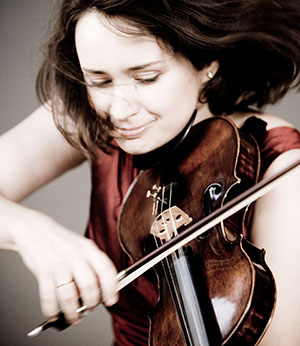
 Left – Patricia Kopatchinskaja. Cover – Patricia Kopatchinskaja. Photos – Marco Borggreve
God love the ACO. It never disappoints. The latest tour, Barefoot Fiddler, is no exception. The inspiration for such is guest artistic director and lead violinist, Patricia Kopatchinskaja who, true to form, plays shoelessly. She's not only shoeless: she seems quite devoid of all the pretences and affectations so commonly associated, at least by way of cliche, with classical music performance. She's as loose as a goose, but without, say, Nigel Kennedy's try-hard outrageousness.
PK appears a little mad, in the best possible way, with her wide-eyed expressions and unconventional postures. But there's method and discipline, along with fierce, frenzied, fanatical passion, in this madness. She espouses teamwork, polyphony and democracy and her barefootedness seems emblematic of her firm, feet-on-the-ground MO. She puts herself on a level playing-field, rather than a pedestal.
However, she probably belongs on that pedestal, for a number of reasons. Firstly, democratic or not, she rides the ACO relentlessly, giving glances and nods of encouragement, throwing down the gauntlet to individual soloists, driving them to personal bests and even into spirited contest with one another. I imagine playing with her is akin to running record time in the City to Surf, but it looks rewarding for them and certain is for us. Secondly, her own virtuosity is prodigious. Not just technically. Nay, this is the least of her gifts. She plays like a demon. Nothing is sacrosanct: she takes the path far less travelled, with any work.
Besides the Moldovan, Kopatchinskaja, both Helena Rathbone and Rebecca Chan were featured, on violins: a triple treat, since the instruments, sound and styles of all three endowed striking contrast and complementation, enriching the chosen music no end. As caprice dictates, PK thrusts other players, including those not necessarily overly accustomed to the solo spotlight, to the fore.
Another unexpected appearance was that of Maxime Bibeau's brand new bass. I say brand new, but it's hardly the kind on the block. In truth, it now ranks as the most antique instrument in the ACO's lockup. Thanks to 'anonymous private benefactors', the bass, made by Gasparo da Salo (as ACO GM Timothy Calnin puts it, the Stradivari of double bass makers), built in 1590, is now proudly owned, in 2013, by the ACO. It's quite a coup. 1590. Calnin puts it in neat historical perspective. Francis Drake had just circumnavigated the earth; Shakespeare married Anne Hathaway; Europeans had their first taste of chocolate.
The programme began with Mozart's Adagio & Fugue, in C Minor (K546), composed in 1788, which afforded immediate aural access to that bass, as well as the vigorous mode in which PK launches into everything. This is a confounding piece as, on the one hand, it requires taut rigour, to adhere to the form; on the other, Mozart, being Mozart, demands feeling. The ACO, under PK, found no contradiction. It seems to me one of Kopatchinskaja's great strengths lies in her eagerness to challenge convention, interrogating old music afresh and finding new ways of rendering it; so as if it's assailing one's ears for the very first time. In other words, she has and is an antidote for staleness. Just to watch her is to see a child (be it a precociously gifted one) experiencing music for the first time. And that energy is catching.
The fugue is one Wolfy had prepared five years earlier, originally for two pianos, but he adapted it for two violins, viola and bass, to bring it in line with the new adagio prelude. Of course, he isn't known for his fugues (even if he is for his contrapuntal excellence in other forms) and yet, Mozart, being Mozart, devised one that's state of the art, even if there's some evidence, or speculation, to suggest he was uncertain about its matchup with the adagio. Incredible as it may seem to us, he appears to have been daunted by Bach's mastery, which rocked his world and shook his confidence; though, I s'pose, if anyone could do that to Mozart, it might've been Bach. But, to any critically objective ear, this stands as a sublime example of polyphonic mastery; the adagio, pregnant with aching melancholy which, if anything, PK seeks to accentuate. This is her way, in all things. Pussyfooting isn't for her. It may be brief, but this preface communicates profoundly, not least on the emotional plane. The allegro movement that follows certainly betrays the influence of Bach, but with an unmistakable Mozartian character that transcends functionality, intellectualism and aestheticism. PK sought and succeeded in imbuing a sense of menacingly explosive latency in what is, compositionally, plaintive.
What better to follow fugue than the fugue-meister, J. S.? Specifically, his Concerto for Three Violins, in D Major (BWV 1064). It was in these three movements we began to get a palpable sense of what PK brings to the direction of the orchestra, with Kopatchinskaja, Rathbone & Chan vying for solo supremacy. It was something more akin to three rock-god guitarists battling it out and, for an audience, at least as gripping. PK even saw fit to augment Bach's notations with introductory fancies and flourishes that seemed absolutely in keeping, while piquing our interest, refreshing our senses and sensibilities, by way of tiny, unexpected surprise packages.
Yes, even with the strict discipline of Bach, Kopatchinskaja brings an almost improvisational quality to bear. Nonetheless, none of Bach's sweetness is sacrificed: the first allegro is spritely and delightful (after Vivaldi, whom Bach more-or-less idolised), with Kopatchinskaja's fingers and entire being dancing to his tune, as well as her own. It's an exquisite tapestry, almost overwhelming in its intricacy. The adagio is, of course, far from merry, in aural slow-motion by way of pained elongation of phrases. But the last movement restores our optimism and affords generous space for the soloists to fete us with their respective talents: Chan was breathtaking, seeming to have no fear in pushing herself right to her limits, if she has them; Rathbone opting for more understated, subtle colouration, hers almost a voice of reason; PK more in keeping with Chan, or vice-versa, with a radical, edgy, daring and dangerous cadenza.
This was seriously spine-tingling, with the orchestra, in stark contrast to the drawn-out middle movement, racing to the denouement. Chamber music really doesn't get any better. The smallish ensemble was bursting at the seams, sounding much bigger than it is.
After an interval, suitably primed, we were in for the adventure of Alberto Ginastera's Concerto for Strings, from 1965. For the uninitiated, Buenos Aires-born Ginastera, despite his works being all too rarely performed, remains one of South America's greatest composers. Piazzolla was among his many pupils. This is avant garde, atonal art music, not to everyone's taste but, as usual, the ACO has the courage to test and challenge its audiences. For serious musicians, there's much to admire and marvel at, of a technical nature. And for the rest of us, there's a distinctive lexicon on which to gnaw. The first movement is especially substantial; a theme and variations, by turns brooding and dramatic. It presents yet another opportunity for PK to demonstrate just how impassioned is her fiddling (I use this descriptor very deliberately and by no means pejoratively, as it's in keeping with the range of textures, from lush to guttural, that characterise this work).
It's a ripe opportunity, as well, for Bibeau to show off his new toy, which doesn't disappoint: an irresistibly warm, yet assertive resonance is apparent and its volume seems to hold up exceptionally well in tutti.
The second, scherzo fantastico movement is both a showcase for Ginastera's intensity and a three-ringed circus of astonishing instrumental effects focussed on timbre, including col legno battuto (the impossibly romantic Italian terminology for hitting the strings with the wood of the bow, which never fails to tread that delicious line between pleasure and pain that comes from buzzing harmonics) and sul ponticello (playing on the bridge). It's very demanding in nature but, unsurprisingly, doesn't so much as ruffle the feathers of the ACO, let alone its guest director, who seems to thrive on the daredevilish.
The third, adagio movement, in contrast, reminds one this could be the score for dark, suspenseful cinema, such is its veiled furtiveness. Emotionally, it's disturbing; aurally, opulent and satiating. And the fade to niente is very finely polished.
Finally, the furioso, as the term implies, is frenetic as all get-up and calls up the spirit of Bartok.
Which left Mendelssohn's Violin Concerto in D Minor. Mendelssohn composed this when he was thirteen, and astonishing, superhuman feat that rockets him way beyond the mundanity of prodigy. It took someone of similarly intergalactic status to discover it: Yehudi Menuhin. What a find. And yet, even despite this imprimatur and provenance, it doesn't seem to have crept, let alone leapt, into the repertoire, proving there's no justice. Perhaps the old school can't, or won't, assent to the young Felix's unseemly precocity, in writing something so sophisticated and eloquent. Even so, in the exciting, rising quarter-note arpeggio, there's almost an impetuosity; an anxiousness to impress, on behalf of the composer, perhaps. Certainly, the ACO endows these undersung pieces with a fresh chance at cracking the classical top one-hundred, in which he has, very arguably, far too few entries. PK's solo less than ninety seconds in on its own reinvigorated the work, with Kopatchinskaja rightly spurning strict tempo in deference to rubato.
Just when we thought it couldn't get any better, there was Piazzolla and one or two other unprogrammed pleasures. All this, in a masterpiece of a building. Long live the SOH. The ACO. And Kopatchinskaja, who really kicks classical arse.
Australian Chamber Orchestra
BAREFOOT FIDDLER
Patricia Kopatchinskaja Guest Director and Violin
Helena Rathbone Violin
Rebecca Chan Violin
2013 DATES & VENUES
Wollongong Town Hall Saturday 20 July, 7.30pm 02 4227 5088
Melbourne – Hamer Hall Sunday 21–22 July, artscentremelbourne.com.au | 1300 182 183
Adelaide Town Hall Tuesday 23 July, bass.net.au | 131 246
Perth Concert Hall Wednesday 24 July, ticketek.com.au | 1300 795 012
Canberra – Llewellyn Hall, ANU Saturday 27 July, ticketek.com.au | 1300 795 012
Sydney Opera House, Concert Hall Sunday 28 July, sydneyoperahouse.com | 02 9570 7777
Brisbane – QPAC Concert Hall Monday 29 July, qtix.com.au | 136 246
Sydney – City Recital Hall Tuesday 30 July – 3 August, cityrecitalhall.com | 02 8256 2222
Sydney Reviews
Barefoot Fiddler | Australian Chamber Orchestra
- Details
- lloyd bradford (brad) syke
Most read Sydney reviews
The Lark | Hey Dowling
Noni Hazlehurst brings Rose and The Lark to colourful and compelling life in this one-woman show.
Pride & Prejudice* (*sort of) | Neil Gooding Productions & Woodward Productions
This rollicking musical take on Jane Austen’s beloved novel is a side-splitting crowd pleaser.
Heartbreak Hotel | EBKM
Heartbreak Hotel invites its audience into an intimate portrait of the universal and isolating experience of heartbreak.
Current | Sydney Dance Company
While Bonachela’s work is, as always, dreamily lovely, for me the highlights were absolutely the three commissioned choreographers: Azzam Mohamed, Jenni Large and Raghav Handa.
The Gospel According to Paul – The Second Coming | Soft Tread Productions
The Gospel According to Paul is meticulously crafted entertainment. It’s uplifting without pulling any punches.
The Gospel According to Paul is meticulously crafted entertainment. It’s uplifting without pulling any punches.

While Bonachela’s work is, as always, dreamily lovely, for me the highlights were absolutely the three commissioned choreographers: Azzam Mohamed, Jenni Large and Raghav Handa.